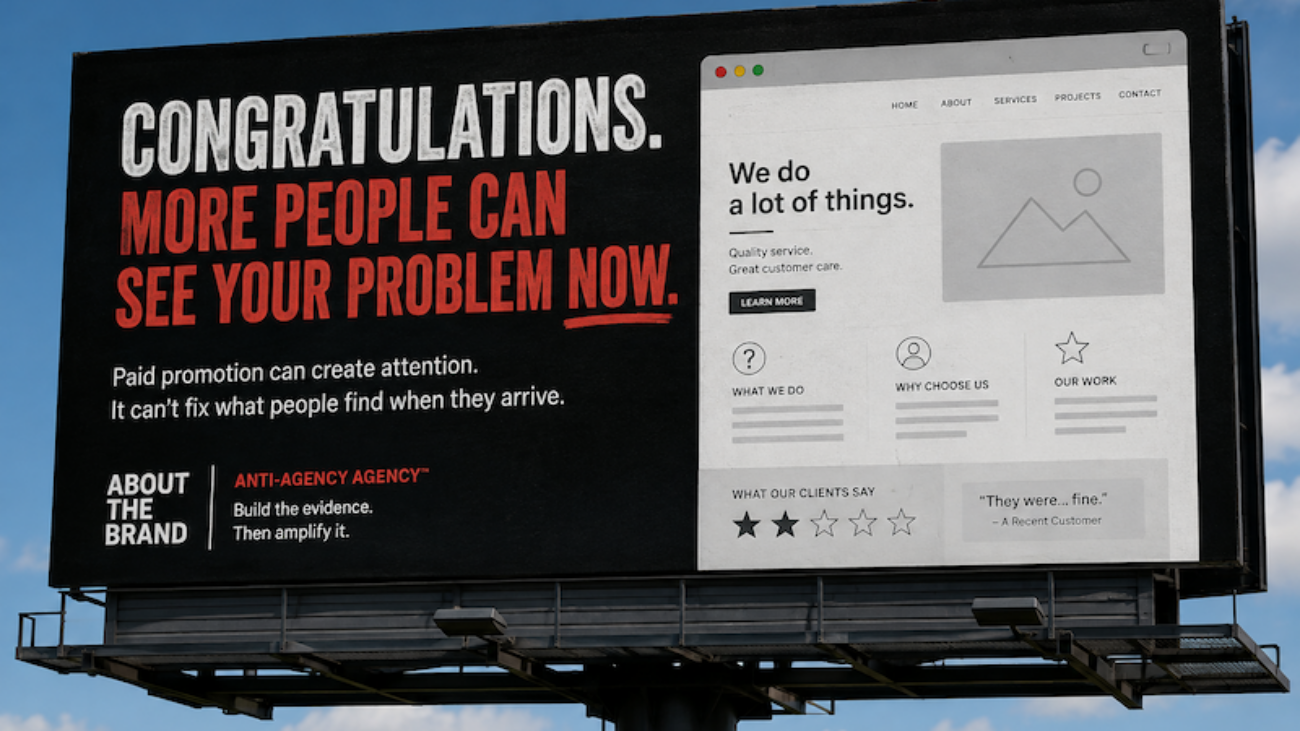
We’re not anti-advertising. We’re anti-paying to promote an underdeveloped digital presence.
Sure,
Google Ads work.
Meta ads work.
SEO works.
Social media works.
Sometimes spending more money promoting your business is exactly what you should do.
But there’s a question that should come first: What exactly are you paying to promote? Because advertising doesn’t fix a weak digital presence. It just amplifies it.
If your website is little more than an online business card, or makes visitors wade through your company history and family photos before figuring out what you actually do, paying for more traffic is like advertising your store, then greeting customers with a family photo album or an obstacle course, making it super hard to find what they came for.
Businesses wouldn’t do that intentionally in the real world, but they pay to do the digital equivalent every day.
More Traffic Isn’t Always the Answer
When a business wants more customers, one of the most common prescriptions is to get more people to the website. Run Google Ads. Boost some social posts. Hire an SEO company.
All of those things can generate attention. But attention isn’t necessarily the problem.
Imagine paying to drive more people to a website that doesn’t clearly explain why someone should choose the business. Or sending paid traffic to a thin service page with generic copy and little proof.
You may get more traffic, but you’ve also paid money to expose the weaknesses that were already there.
Advertising Is an Amplifier
Advertising can create attention, but it cannot automatically create credibility. It can’t manufacture a compelling message, explain expertise you haven’t documented, or make someone trust your business once they arrive.
Advertising alone cannot:
- – Fix unclear or generic messaging
- – Turn a thin service page into a convincing one
- – Create case studies or proof that haven’t been documented
- – Make an outdated website represent the business today
- – Give Google or AI search engines evidence about expertise that barely exists online
That’s a big part of the thinking behind our Active Brand Campaign approach: strengthen what people find before spending more to send them there.
Build the Evidence Before Buying the Attention
Too often, the marketing sequence looks like this:
Need more business → Need more traffic → Spend money promoting the business.
We’d rather look at what happens after someone discovers the business.
Can they quickly understand what you do and why you’re different? Does your website reflect the business you are today? Are your most important services properly represented? Can people see your expertise, projects, reviews and customer stories?
And perhaps most importantly:
If twice as many people discovered your business tomorrow, would your digital presence give them enough reason to choose you?
If the answer is no, buying more attention probably isn’t the first problem to solve.
Improving pages, developing useful content, documenting proof and responding to what search data tells us is exactly what we focus on through the Active Brand Campaign.
Your Business May Be Better Than Your Digital Presence Makes It Look
This is especially common with established businesses.
The company may be excellent. Customers love them. The owner may have decades of experience, and the team may complete impressive projects every week.
But surprisingly little of that ever makes it online.
Projects aren’t documented. Customer questions never become useful content. Expertise stays inside people’s heads. Great customer stories disappear after the job is finished. Meanwhile, the business keeps evolving while its digital presence remains relatively static.
Eventually, there’s a gap between how good the business actually is and how good the business looks online.
That’s a dangerous gap to start paying to promote.
Search Is Becoming an Evidence Game
People aren’t only searching Google and clicking through a list of websites anymore. They’re asking increasingly specific questions, and Google and AI platforms are increasingly trying to provide the answers.
Businesses need more than the right keywords. They need evidence.
If you’re an expert in something, demonstrate it. If you perform an important service, build a substantial page around it. If customers repeatedly ask the same questions, answer them. If you’ve completed impressive work, document it. If you’ve solved difficult problems, tell those stories.
That evidence can include:
- – Strong service and authority pages
- – Helpful articles answering real customer questions
- – Case studies and completed projects
- – Testimonials and reviews
- – FAQs
- – Photos and video
- – Credentials, experience and company history
This isn’t about pumping out meaningless content because someone said you need to “do SEO.” It’s about making your real-world expertise visible, understandable and searchable.
Then Turn Up the Volume
None of this means we’re against advertising. Quite the opposite.
Once the message is clear, the website reflects the quality of the business, important pages are developed, useful content supports them and the proof is visible — then turn up the volume.
Run the Google Ads. Promote the content. Invest further in SEO. Expand the audience.
Now you’re not asking advertising to compensate for an underdeveloped presence. You’re using it to amplify a strong one.
That’s ultimately the philosophy behind the Active Brand Campaign: build a stronger organic foundation first, then make smarter decisions about when additional promotion makes sense.
Before You Buy More Attention
Maybe your business needs Google Ads. Maybe it needs SEO. Maybe it needs more social media. Maybe it needs all three.
But those are prescriptions.
And prescriptions should come after diagnosis.
Before asking, “How do we get more people to see us?”
Ask, “What are they going to see when they do?”
Because sometimes the smartest marketing investment isn’t buying more attention. It’s becoming more worthy of the attention you’re already getting.
Build the evidence. Strengthen the presence. Then amplify it.
The Active Brand Campaign is built around exactly that idea: continually strengthening your digital presence through better content, stronger website pages, documented expertise and proof, search trends, and real performance data.
The goal is simple: make your business easier to find, understand and trust organically, so when you do invest in paid promotion, you’re amplifying something that’s already working.